What “EV” actually means in video poker
Every strategy argument ends at the same place: expected value. Here's what the number is, where it comes from, and why a trainer that shows it beats one that just says “wrong.”
EV is the average of every possible future
Hold two cards and the machine will deal one of exactly 16,215 possible 3-card draws. Video poker’s beautiful property is that you can check all of them. The expected value of a hold is the payout of every one of those futures, averaged. Not a prediction of this hand — a price tag on the decision. Make +EV decisions and the long run must follow; that's arithmetic, not philosophy.
A real decomposition: the humble low pair
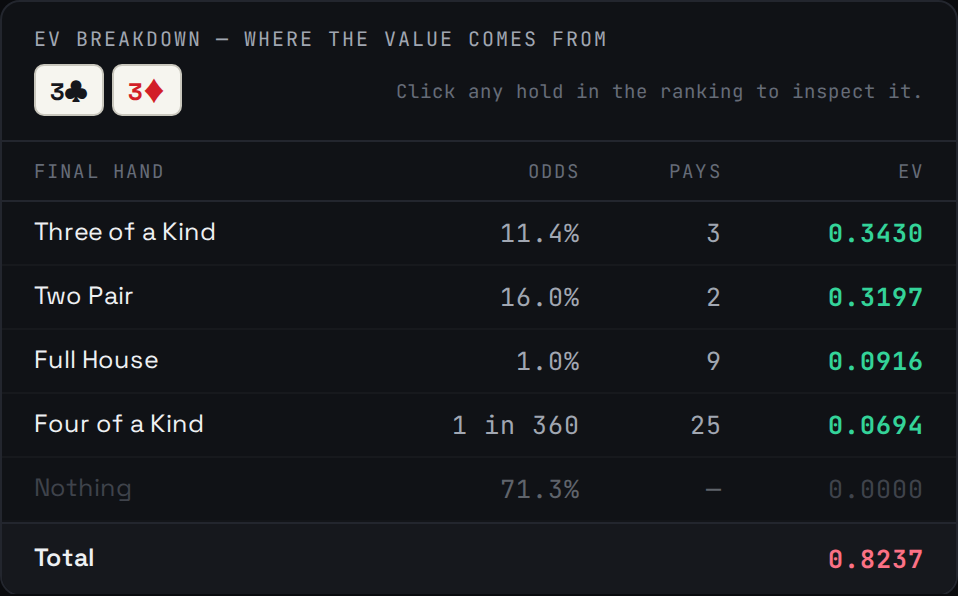
Hold 3♣ 3♦ and throw three cards. Enumerating all 16,215 draws on 9/6 Jacks or Better:
That 0.8237 is the low pair’s exact worth, per coin. Now the famous dilemmas stop being opinions: a 4-to-a-flush in the same hand computes to 1.2128 — so the flush draw wins — while an open-ended straight draw computes to 0.6809, so the pair wins. Same pair, opposite answers, and you never have to remember which “feels” right again.
EV loss: the only feedback that teaches
When a trainer says “wrong,” you learn that you were wrong. When it says “your hold: 0.6753, best: 0.8237 — this habit costs 0.148 per bet,” you learn how much to care. Keeping a kicker (−0.148) deserves a week of drilling; a borderline 3-to-royal call (−0.005) doesn’t. Ranking your mistakes by EV loss is how 20 minutes of practice a day goes to the right place — it’s the entire design of the trainer and its weak-spot drills.
Two footnotes the marketing versions skip
EV assumes max bet (the royal’s 800-per-coin exists only at five coins), and EV says nothing about tonight — 71.3% of those low-pair holds still end in nothing. Variance is real; EV just guarantees the price you pay for playing badly. The numbers here are exact, not simulated: the methodology and its verification. For how often each final hand actually arrives, see the exact odds of every hand; for what variance means for your wallet, bankroll & variance.